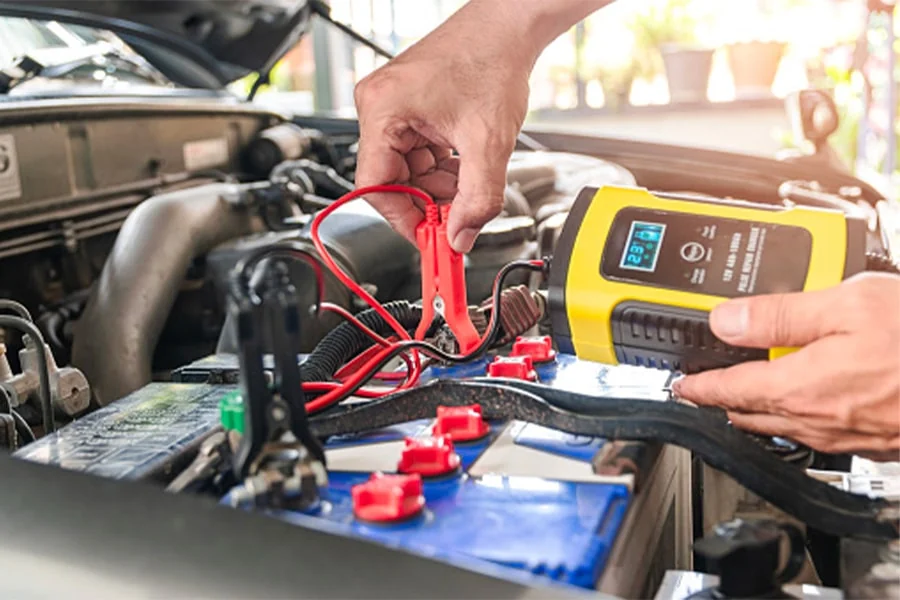
A car battery charger recharges a flat battery. This guide explains how it works, what to check when choosing one and how it differs from a jump starter.
How does a car battery charger work?
First, remember that the battery is essential to the operation of your vehicle. It supplies the power needed to start the engine and run the electrical accessories.
The battery supplies power each time you start the engine, and the alternator recharges it as you drive. If your battery is flat or if you rarely drive or only make short journeys (which may leave the battery undercharged), a compatible charger can help.
Its job is to recharge the battery. Unlike the alternator, a mains charger works with the engine switched off. The setup is straightforward : connect it to the mains and the specified charging points as directed.
Which car battery charger should you choose?
Consider several factors when choosing a charger that suits your vehicle.
- The rated voltage should match your battery’s voltage (use a compatible 12 V mode for a 12 V battery).
- The charging current is measured in amps. Choose a charger that is compatible with your battery’s capacity and chemistry.
The battery label lists its capacity in amp-hours (Ah). Charging current is measured in amps (A).
A 5 A charger may suit a 50 Ah battery if it supports the battery’s voltage, chemistry and capacity range. Check the manufacturer’s specifications.
Compare charging modes, charge indicators and supported battery types. A jump starter delivers a short burst of power to start the engine. A mains charger restores battery charge over time. Consult a motoring handbook.
Car battery charger: our NOCO selection
To keep a battery charged while the car is laid up, we chose two chargers from the NOCO GENIUS range. The manufacturer states up to 5 A for the GENIUS5 and up to 10 A for the GENIUS10; both offer modes for 6 V and 12 V lead-acid batteries and a 12 V lithium mode for compatible batteries.
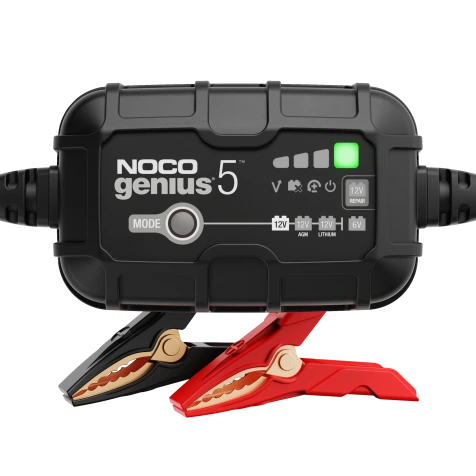
NOCO GENIUS5: 5 A battery charger for 6 V and 12 V
A mains charger to consider for charging and maintaining a compatible battery while the vehicle is unused.
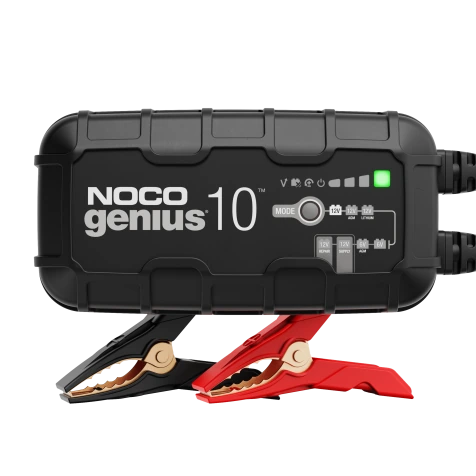
NOCO GENIUS10: 10 A battery charger for 6 V and 12 V
A mains charger for weighing up a higher charging output against your battery’s actual needs.
Battery already flat: use a jump starter
A charger is no substitute for a jump starter: if the car has to start straight away, that is what you need. NOCO states 1,000 A for the Boost GB40 (petrol engines up to 6.0 l and diesel up to 3.0 l) and 1,250 A for the Boost X GBX45 (petrol up to 6.5 l, diesel up to 4.0 l), which recharges via USB-C at up to 60 W.
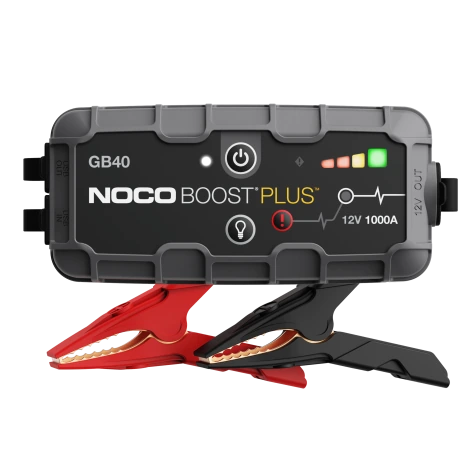
NOCO Boost GB40: 12 V jump starter
A portable jump starter to provide starting assistance when the battery has insufficient charge.
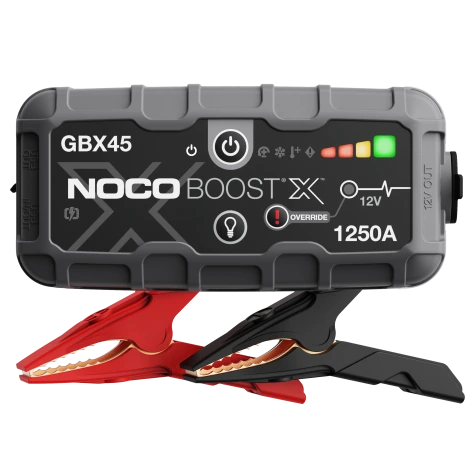
NOCO Boost X GBX45: 12 V jump starter with USB-C charging
A jump starter to consider if you want starting assistance and USB-C Power Delivery charging.
How to use a car battery charger
Switch off the engine and all electrical accessories before charging the battery.
How to connect the charger
- With the charger unplugged, attach the clamps to the points specified in the vehicle and charger manuals. If the battery is fitted in the vehicle, you may need to use a dedicated earth point.
- Check the connections, then plug in the charger as directed and select the mode that matches the battery’s voltage and chemistry.
Wait until the charger indicates that charging is complete. Charging time depends on the charger, battery capacity and starting state of charge.
Battery life depends on its condition and how the vehicle is used. A compatible maintenance charger can help if the car mainly does short trips or is parked for long periods. Follow the manufacturer’s guidance.